How Followers of Islam Responded in Art to Iconoclasm
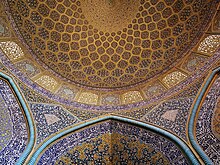
Aniconism is the avoidance of images of sentient beings in some forms of Islamic art. Islamic aniconism stems in part from the prohibition of idolatry and in part from the conventionalities that the cosmos of living forms is God's prerogative. Although the Quran does not explicitly prohibit visual representation of whatsoever living being, it uses the discussion musawwir (maker of forms, artist) every bit an epithet of God. The corpus of hadith (sayings attributed to the Islamic prophet Muhammad) contains more explicit prohibitions of images of living beings, challenging painters to "exhale life" into their images and threatening them with penalisation on the Twenty-four hour period of Judgment.[1] [ii] Muslims accept interpreted these prohibitions in different means in unlike times and places. Religious Islamic fine art has been typically characterized past the absence of figures and all-encompassing employ of calligraphic, geometric and abstract floral patterns.
Yet, representations of Muhammad (in some cases, with his face concealed) and other religious figures are establish in some manuscripts from lands to the eastward of Anatolia, such as Persia and Republic of india. These pictures were meant to illustrate the story and not to infringe on the Islamic prohibition of idolatry, but many Muslims regard such images as forbidden.[one] In secular fine art of the Muslim world, representations of man and animal forms historically flourished in well-nigh all Islamic cultures, although, partly because of opposing religious sentiments, figures in paintings were often stylized, giving ascension to a multifariousness of decorative figural designs. In that location were episodes of iconoclastic devastation of figurative art, such every bit the decree by the Umayyad caliph Yazid II in 721 CE ordering the destruction of all representational images in his realm.[2] [3] A number of historians have seen an Islamic influence on the Byzantine iconoclastic motility of the eighth century, though others regard this is every bit a fable that arose in later times in the Byzantine empire.[4]
Theological views [edit]
The Quran, the Islamic holy book, does not explicitly prohibit the depiction of human figures; it but condemns idolatry.[5] [vi] Interdictions of figurative representation are present in the hadith, amongst a dozen of the hadith recorded during the latter part of the period when they were being written downwardly. Because these hadith are tied to detail events in the life of the Islamic prophet Muhammad, they need to be interpreted in order to be applied in any general manner.
Sunni exegetes of tafsir, from the ninth century onward, increasingly saw in them chiselled prohibitions against producing and using any representation of living beings. At that place are variations betwixt religious madhhab (schools) and marked differences between unlike branches of Islam. Aniconism is common amongst fundamentalist Sunni sects such as Salafis and Wahhabis (which are too often iconoclastic), and less prevalent among liberal movements within Islam. Shia and mystical orders also have less stringent views on aniconism. On the private level, whether or not specific Muslims believe in aniconism may depend on how much credence is given to hadith, and how liberal or strict they are in personal practice.
Aniconism in Islam not only deals with the fabric paradigm, just touches upon mental representations as well. Information technology is a problematic event, discussed by early theologians, as to how to describe God, Muhammad and other prophets, and, indeed, if it is permissible at all to do so. God is usually represented by immaterial attributes, such every bit "holy" or "merciful", commonly known from His "Ninety-nine beautiful names". Muhammad'due south concrete appearance, nonetheless, is amply described, particularly in the traditions on his life and deeds recorded in the biographies known as Sirah Rasul Allah. Of no less interest is the validity of sightings of holy personages fabricated during dreams.
Titus Burckhardt sums upward the office of aniconism in Islamic aesthetics as follows:
The absence of icons in Islam has not merely a negative but a positive office. Past excluding all anthropomorphic images, at to the lowest degree within the religious realm, Islamic art aids human being to exist entirely himself. Instead of projecting his soul outside himself, he can remain in his ontological centre where he is both the viceregent (khalîfa) and slave ('abd) of God. Islamic fine art every bit a whole aims at creating an ambient which helps man to realize his primordial nobility; it therefore avoids everything that could exist an 'idol', even in a relative and provisional manner. Nothing must stand between man and the invisible presence of God. Thus Islamic art creates a void; it eliminates in fact all the turmoil and passionate suggestions of the world, and in their stead creates an society that expresses equilibrium, serenity and peace.[vii]
In practice [edit]

Religious core [edit]
In exercise, the cadre of normative religion in Islam is consistently aniconic. Spaces such as the mosque and objects like the Quran are devoid of figurative images. Other spheres of organized religion, for example mysticism, popular piety, or private devotion exhibit significant variability in this regard. Aniconism in secular contexts is fifty-fifty more than variable and there are many examples of figural representation in secular fine art throughout history. More often than not speaking, aniconism in Islamic societies is restricted in mod times to specific religious contexts. In the past, it was enforced just in some times and places.[eight]
Past [edit]
The representation of living beings in Islamic art is not simply a modern phenomenon and examples are constitute from the earliest periods of Islamic history. Frescos and reliefs of humans and animals adorned palaces of the Umayyad era, as on the famous Mshatta Facade now in Berlin.[nine] [ten] The 'Abbasid Palaces at Samarra also contained figurative imagery. Ceramics, metalware, and objects in ivory, rock crystal, and other media likewise bore figural imagery in the medieval era.[xi] Figurative miniatures in books occur later on in well-nigh Islamic countries but somewhat less in Standard arabic-speaking areas. The human effigy is primal to the Persian miniature and other traditions such as the Ottoman miniature and Mughal painting.[12] [xiii] The Persian miniature tradition began when Persian courts were dominated by Sunnis, but continued after the Shia Safavid dynasty took power. The Safavid ruler Shah Tahmasp I of Persia began his reign equally a smashing patron and amateur creative person himself, merely turned against painting and other forbidden activities later a religious midlife crunch.[14]
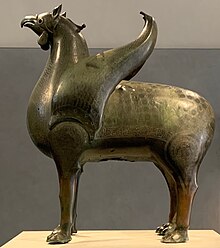
The Pisa Griffin, probably created in the 11th century in Al-Andalus, is the largest Islamic figurative sculpture to survive.
The avoidance of idolatry is the main concern of the restrictions on images, and every bit a result, the traditional grade for the religious cult image, the free-standing sculpture, is extremely rare, though examples of freestanding human sculpture practise occur in Umayyad Syrian arab republic and in Seljuk Iran.[15] The Pisa Griffin, of a mythical beast and designed to spout water for a fountain, is the largest example, at three anxiety tall in bronze, and probably but survives because it was taken as booty by the city of Pisa in the Middle Ages.[sixteen] Like the famous lions supporting a fountain in the Alhambra, it probably came from Al-Andalus. The griffin and lions cannot easily be regarded every bit potential idols, given their submissive position (and the lack of religions worshipping lions or griffins), and the same is true of small decorative figures in relief on objects in metalwork, or figures painted on Islamic pottery, both of which are relatively common.[17] In particular hunting scenes of humans and animals were popular, and presumably regarded as clearly having no religious function. The figures in miniatures were, until the late 16th century, always numerous in each image, small (typically only an inch or 2 high), and showing the cardinal figures at roughly the same size as the attendants and servants who are normally also shown, thus deflecting potential accusations of idolatry. The books illustrated were nigh often the classics of Persian poetry and historical chronicles.
The hadith show some concessions for context, as with the dolls, and condemn near strongly the makers rather than the owners of images.[18] A long tradition of prefaces to muraqqas sought to justify the creation of images without getting involved in discussions of the specific texts, using arguments such every bit comparing God to an artist.[19]
Miniature painting was generally patronized by the court circle and is a private form of art; the owner chooses whom to show a volume or muraqqa (anthology). Just wall-paintings with big figures were plant in early Islam, and in Safavid and subsequently Persia, particularly from the 17th century, but were always rare in the Arabic-speaking world. Such paintings are also mainly institute in private palaces; examples in public buildings are rare though not unknown, in Iran in that location are even some in mosques.
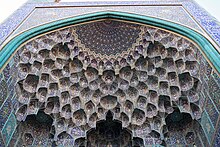
Eschewing figural representation, ornamentation in Islamic sacred architecture relies chiefly on arabesque and geometrical patterns.
Early examples of non-figural representation in Islamic sacred architecture are found in the Umayyad Mosque of Damascus and the Dome of the Stone. The murals of the Dome of the Rock use crowns and jewels to symbolize earthly rulership and "otherworldly" plants as an invocation of the Quranic description of heaven.[xx] Similarly, the murals in the Umayyad Mosque of Damascus, which depict an idyllic cityscape are also meant to exist an evocation of paradise without figural representation.[20]
The issue of aniconism has posed problems in the mod world, especially as technologies like television developed in the 20th century. For many years, Wahhabi clerics opposed the establishment of a television service in Kingdom of saudi arabia, as they believed it immoral to produce images of humans.[21] The introduction of tv in 1965 offended some Saudis, and one of King Faisal's nephews, Prince Khalid ibn Musa'id ibn 'Abd al-'Aziz,[22] was killed in a police shootout in Baronial 1965 subsequently he led an assault on one of the new idiot box stations.[23]
Nowadays [edit]
Depending on which segment of Islamic societies are referred to, the application of aniconism is characterized past noteworthy differences.[24] Factors are the epoch considered, the country, the religious orientation, the political intent, the popular beliefs, the private do good or the dichotomy betwixt reality and discourse.
Today, the concept of an aniconic Islam coexists with a daily life for Muslims awash with images. TV stations and newspapers (which do present still and moving representations of living beings) have an exceptional impact on public opinion, sometimes, as in the instance of Al Jazeera, with a global reach, across the Arabic speaking and Muslim audition. Portraits of secular and religious leaders are omnipresent on banknotes[25] [26] and coins, in streets and offices (east.g. presidents similar Nasser and Mubarak, Arafat, al-Assad or Hezbollah'southward Nasrallah and Ayatollah Khomeini). Anthropomorphic statues in public places are to be found in most Muslim countries (Saddam Hussein's are infamous[27]), likewise as fine art schools training sculptors and painters. In the Egyptian countryside, information technology is fashionable to celebrate and advertise the returning of pilgrims from Mecca on the walls of their houses.
The Taliban motility in Afghanistan banned photography and destroyed non-Muslim artifacts, particularly carvings and statues such every bit the Buddhas of Bamiyan, more often than not tolerated by other Muslims, on the grounds that the artifacts are idolatrous or shirk. Withal, sometimes those who profess aniconism volition practice figurative representation (cf. portraits of Talibans from the Kandahar photographic studios during their imposed ban on photography[28]).
For Shia communities, portraits of the major figures of Shiite history are of import elements of religious devotion. In Iran, portraits of Muhammad and of Ali, printed on pieces of textile or woven into carpets, are called temsal ("likenesses") and tin can exist bought around shrines and in the streets, to exist hung in homes or carried with oneself.[29] In Pakistan, India and Bangladesh portraits of Ali can be plant on notoriously ornate trucks,[30] buses and rickshaws.[31] Contrary to the Sunni tradition, a photographic motion-picture show of the deceased tin can exist placed on the Shiite tombs.[32] [33] A curiosity in Iran is an Orientalist photography supposed to represent Muhammad equally a young boy.[34] The Yard Ayatollah Sistani of Najaf in Republic of iraq has given a fatwā declaring the depiction of Muhammad, the prophets and other holy characters, permissible if it is fabricated with the utmost respect.[35]
Circumvention methods [edit]
Medieval Muslim artists found various ways to represent especially sensitive figures such as Muhammad. He is sometimes shown with a peppery halo hiding his face, head, or whole body, and from about 1500 is often shown with a veiled face.[36] Members of his immediate family and other prophets may be treated in the same fashion. At the material level, prophets in manuscripts can accept their face covered by a veil or all humans have a stroke fatigued over their cervix, symbolizing the severing of the soul, and clarifying the fact that it is not something alive and imbued with a soul that is depicted: a purposeful flaw to make what is depicted impossible to live in reality (as merely incommunicable in reality is yet often frowned upon or banned, such every bit representations of comic book characters or unicorns, although exceptions do exist). Few portraits were attempted, and the power to create recognizable portraits was rare in Islamic art until the Mughal tradition began in the tardily 15th century, although in both Mughal India and Ottoman Turkey portraits of the ruler then became very popular in court circles.[37]

Islamic calligraphy has also displayed figurative themes. Examples of this are anthropomorphic and zoomorphic calligrams.[38] Islamic calligraphy forms evolved, especially in the Ottoman period, to fulfill a function similar to figurative art.[39] When on paper, Islamic calligraphy is oft seen with elaborate frames of Ottoman illumination.[39] Examples of Islamic calligraphy using this technique include the proper noun of Muhammad, the Hilya (a tablet that embodies the description of Muhammad'southward physical advent), multiple names of God in Islam, and the tughra (a calligraphic version of the name of an Ottoman sultan).[forty] [41]
Causes [edit]
Hadith and exegesis examples [edit]
During its early on days, aniconism in Islam was intended as a measure out against idolatry, particularly against the statues worshipped by pagans. All hadith presented in this section are Sunni, non Shia.
Narrated Aisha:
The wife of the Prophet purchased a cushion with pictures of animals on it for the Prophet to sit on and recline on. The Prophet disapproved of the making of such pictures, maxim the makers would be punished on the Day of Resurrection when God would ask them to bring their creations to life. The Hadith also reports that the Prophet said that the angels would not enter a business firm where there are pictures.
Narrated Aisha, Ummul Mu'minin:
Upon the Prophet'southward inflow from a military expedition, a drapery covering Aisha'southward shop-room was raised by the blowing wind, uncovering her dolls. Among them, the Prophet saw a horse with two wings made of rags and asked his wife what was on the horse. Aisha responded that it was two wings. He asked: A equus caballus with two wings? Aisha then asked if the Prophet had not heard that Solomon had horses with wings. The Hadith reports that the Prophet laughed heartily where his molar teeth were seen.—Abu Dawood, Sunan Abu Dawood [43],
Reference (English Book) Volume 42, Hadith 4914
Reference (Arabic Book) Book 43, Hadith 160
Narrated Ali ibn Abu Talib:
Safinah AbuAbdurRahman, Ali ibn Abu Talib, and Fatimah invited the Prophet to consume with them. Upon the Prophet's arrival, he turned abroad later seeing figural curtains hanging at the end of the firm. Ali followed the Prophet to ask what had turned him dorsum. The Prophet stated that information technology is unfitting for him or whatsoever Prophet to enter a home decorated [with figural imagery].—Abu Dawood, Sunan Abu Dawood [44],
Reference (English Volume) Volume 27, Hadith 3746
Reference (Arabic Volume) Book 28, Hadith 20
Narrated 'Aisha:
Upon the arrival of the Prophet from a journey, he saw and tore a curtain with pictures his wife had placed over the door of a sleeping accommodation. The Prophet disapproved of the making of such pictures, maxim those who endeavor to brand the like of Allah's creations will receive the severest punishment on the Day of Resurrection.—Muhammad al-Bukhari, Sahih al-Bukhari [45],
Reference (English Book) Vol. 7, Volume 72, Hadith 838
Reference (Standard arabic Volume) Book 77, Hadith 6019
To prove the superiority of the monotheist religion, Muhammad smashed the idols at the Kaaba. He also removed paintings that were blasphemous to Islam, while protecting others (the images of Mary and Jesus) within the building.[46] The hadith below emphasizes that aniconism depends non only on what, but also on how things are depicted.
Narrated Ibn Abbas:
The Prophet refused to enter the Ka'ba with idols in information technology and ordered they be removed. Pictures of Abraham and Ishmael holding arrows of divination were carried out and the Prophet stated, "May Allah ruin the infidels for the false portrayal of the acts of Abraham and Ishmael. The Hadith reports that the Prophet said "Allahu Akbar" inside all directions of the Ka'ba and left without prayer therein.—Muhammad al-Bukhari, Sahih al-Bukhari [47],
Reference (English Book) Vol. 5, Book 59, Hadith 584
Reference (Arabic Book) Book 64, Hadith 4333
Muslim b. Subaih reported existence in a business firm with Masriuq which had portrayals of Mary. Masriuq had heard Abdullah b, Mas'ud stating that the Prophet had said the most grievously tormented people on the Day of Resurrection would be the painters of pictures. Later this bulletin was read before Nasr b. 'Ali al-Jahdhami and other narrators, the last i beingness Ibn Sa'id b Abl at Hasan, i person asked for a religious verdict for ane like himself who paints pictures. Ibn 'Abbas narrated to the person the Prophet'southward sayings in which all painters who make pictures would be punished in the fire of Hell and the soul will be breathed in every picture prepared by him. Only pictures of paintings of trees and lifeless things should be immune.
Although pagans in Muhammad's times also worshiped trees and stones, Muhammad opposed only images of animated beings — humans and animals —, as reported past the hadith. Subsequently, geometrical ornamentation became a sophisticated art form in Islam.
Narrated Said bin Abu Al-Hasan:
Said bin Abu Al-Hasan narrates a conversation between a panicked man who makes his living by making pictures with Ibn 'Abbas. Ibn 'Abbas relays the message heard from the Prophet that whoever makes a picture will be endlessly punished by Allah until he is able to put life into it - though he alleged that would never exist possible. The Hadith reports Ibn 'Abbas further advised the panicked man to make pictures of copse and any other inanimate objects.—Muhammad al-Bukhari, Sahih al-Bukhari [49],
Reference (English Book) Vol. 3, Book 34, Hadith 428
Reference (Arabic Book) Book 34, Hadith 172
A'isha reported: The Prophet's wife describes owning a mantle with bird portraits. The Prophet asked for the pall to exist inverse, for when he entered the room it brought to him pleasures of worldly life. Aisha describes too having worn sheets with silk badges, which the Prophet did non command to be torn.
—Muslim ibn al-Hajjaj, Sahih Muslim [fifty],
Reference (English Book) Book 24, Hadith 5255
Reference (Arabic Volume) Book 38, Hadith 5643
Aisha describes the Prophet tearing a curtain with portraits on it as soon as he saw it. The Hadith reports that the Prophet said the most grievous torment from the Paw of Allah on the Mean solar day of Resurrection would be for those who imitate (Allah) in the human action of His creation. The torn pieces were fabricated into cushions.
—Muslim ibn al-Hajjaj, Sahih Muslim [51],
Reference (English Book) Book 24, Hadith 5261
Reference (Arabic Volume) Book 38, Hadith 5650
Muhammad too warned his followers of dying among people that built places of worship at graves and placed pictures in it (i.e. Christians).
Narrated 'Aisha:
When the Prophet became ill, amongst his wives there was talk of a church building in Ethiopia with descriptions of its beauty and pictures information technology contained. The Hadith reports the Prophet maxim the creators are the worst creatures in the sight of Allah for they are the people who, upon the decease of a pious man amid them, make a place of worship at his grave and create pictures in it.—Muhammad al-Bukhari, Sahih al-Bukhari [52],
Reference (English Book) Vol. ii, Volume 23, Hadith 425
Reference (Arabic Book) Book 23, Hadith 425
Muhammad made it very articulate that angels do not similar pictures.
Narrated Abu Talha:
The Prophet said that the angels do not enter houses where there are pictures. The sub-narrator Busr describes having visited Zaid who became sick, then witnessing a curtain hung at his door with a picture show on it that he had spoken about two days prior to becoming ill.—Muhammad al-Bukhari, Sahih al-Bukhari [53],
Reference (English Book) Vol. vii, Book 72, Hadith 841
Reference (Arabic Volume) Book 77, Hadith 6023
Narrated Salim's father:
Upon Gabriel's delay to visit the Prophet, he stated that they exercise non enter a place in which there is a moving picture or a dog—Muhammad al-Bukhari, Sahih al-Bukhari [54],
Reference (English Volume) Vol. vii, Book 72, Hadith 843
Reference (Standard arabic Book) Book 77, Hadith 6026
See also [edit]
- Aniconism in Christianity
- Aniconism in Judaism
- Taghut
- Censorship by religion
- Censorship in Islamic societies
- Destruction of early Islamic heritage sites in Saudi Arabia
- Destruction of cultural heritage by ISIL
- Jyllands-Posten Muhammad cartoons controversy
- Yazid Two, an Umayyad caliph who issued an iconoclastic edict in 721 CE
- Criticism of Twelver Shia Islam#Image veneration
Notes [edit]
- ^ a b Esposito, John 50. (2011). What Anybody Needs to Know almost Islam (2nd ed.). Oxford University Printing. pp. 14–15.
- ^ a b "Figural Representation in Islamic Art". The Metropolitan Museum of Art.
- ^ Wolfram Drews (2011). "Jewish or Islamic Influence? The Iconoclastic Controversy Dispute". Cultural Transfers in Dispute. Representations in Asia, Europe and the Arab World since the Middle Ages. Germany: Campus Verlag. p. 42.
- ^ Wolfram Drews (2011). "Jewish or Islamic Influence? The Iconoclastic Controversy Dispute". Cultural Transfers in Dispute. Representations in Asia, Europe and the Arab World since the Center Ages. Deutschland: Campus Verlag. pp. 55–sixty.
- ^ Esposito, John L. (2011). What Everyone Needs to Know about Islam. Oxford University Press. pp. xiv–fifteen. ISBN9780199794133.
- ^ Quran 5:87–92, 21:51–52
- ^ Titus Burckhardt (1 Oct 1987). Mirror of the intellect: essays on traditional science & sacred fine art. SUNY Printing. p. 223. ISBN978-0-88706-684-ix . Retrieved 12 December 2011.
- ^ Gruber, Christiane J., 1976-. The Praiseworthy One : the Prophet Muhammad in Islamic texts and images. Bloomington, Indiana, United states. ISBN 978-0-253-02526-5. OCLC 1083783078.
- ^ Allen, Terry, "Aniconism and Figural Representation in Islamic Fine art", Palm Tree BooksArchived March three, 2016, at the Wayback Auto
- ^ Educational Site: Archaeological Sites: Qusayr `Amra Archived 2016-08-26 at the Wayback Machine
- ^ Hoffman, Eva R. (2008-03-22). "Betwixt East and W: The Wall Paintings of Samarra and the Construction of Abbasid Princely Culture". Muqarnas Online. 25 (ane): 107–132. doi:10.1163/22118993_02501005. ISSN 0732-2992.
- ^ Reza Abbasi Museum Archived September 27, 2016, at the Wayback Machine
- ^ "Portraits of the Sultans," Topkapi Palace Museum Archived November 20, 2008, at the Wayback Machine
- ^ Dickson, Martin (1958). Sháh Tahmásb and the Úzbeks (the duel for Khurásán with ʻUbayd Khán; 930-946/1524-1540). Ph.D. dissertation, Princeton University. p. 190.
- ^ Canby, Sheila R, Deniz Beyazit, Martina Rugiadi, A. C. South Peacock, and N.Y.) Metropolitan Museum of Art (New York. Court and Cosmos: The Swell Age of the Seljuqs, 2016, p. xl-47
- ^ Mack, p. three Archived June x, 2016, at the Wayback Motorcar
- ^ Canby, Sheila R, Deniz Beyazit, Martina Rugiadi, A. C. Southward Peacock, and N.Y.) Metropolitan Museum of Art (New York. Courtroom and Cosmos: The Great Age of the Seljuqs, 2016, p. 121
- ^ The image contend : figural representation in Islam and beyond the world. Gruber, Christiane J., 1976-. London. ISBN 978-i-909942-34-9. OCLC 1061820255.
- ^ Roxburgh, David J. Prefacing the Image: The Writing of Art History in Sixteenth-Century Iran. Studies and Sources in Islamic Art and Architecture, v. 9. Leiden ; Brill, 2001.
- ^ a b George, Alain. Paradise or Empire?: On a Paradox of Umayyad Art. Power, Patronage, and Memory in Early Islam (2018). Oxford Academy Press.
- ^ Boyd, Douglas A. (Winter 1970–71). "Saudi Arabian Tv set". Journal of Broadcasting. 15 (one).
- ^ R. Hrair Dekmejian (1995). Islam in Revolution: Fundamentalism in the Arab World. Syracuse University Press. p. 133. ISBN 978-0-8156-2635-0. Retrieved 2013-02-13.
- ^ "Saudi Fourth dimension Bomb?". Frontline PBS.
- ^ See 'Sura' and 'Taswir' in Encyclopaedia of Islam
- ^ Petroleum-related banknotes: Kingdom of saudi arabia: Oil Refinery Archived July 20, 2011, at the Wayback Car
- ^ Petroleum-related banknotes: Iran: Abadan Refinery, Iahanshahi-Amouzegar Archived July 20, 2011, at the Wayback Machine
- ^ David Zucchino "U.S. military machine, non Iraqis, behind toppling of statue" Honolulu Advertiser, July v, 2004 Archived March 3, 2016, at the Wayback Machine
- ^ Jon Lee Anderson, Thomas Dworzak, Taliban, London (UK), Trolley, 2003, ISBN 0-9542648-5-1.
- ^ Dabashi, Hamid (2011). Shi'ism - A Religion of Protest. Cambridge, MA: The Belknap Press of Harvard University Press. pp. 29–30.
- ^ Saudi Aramco Globe : Masterpieces to Go: The Trucks of Pakistan Archived October eight, 2014, at the Wayback Automobile
- ^ The Rickshaw Arts of Bangladesh Archived October 21, 2009, at the Wayback Machine
- ^ Moving picture of Golestan e Shohoda cemetery Esfahan -Esfahan, Iran Archived October 18, 2012, at the Wayback Machine
- ^ Mashad Martyrs Cemetery at Best Islamic republic of iran Travel.com Archived April 7, 2015, at the Wayback Machine
- ^ Photography past Lehnert & Landrock, titled "Mohamed", Tunis, c. 1906. Nicole Canet, Lehnert & Landrock. Photographies orientatlistes 1905-1930. (Paris: Galerie Au Bonheur du Jour, 2004): encompass, p. 9. expressionless link Archived May 18, 2006, at the Wayback Machine . Historical context described in (in French) Patricia Briel, letemps.ch, 22 February 2006. Ces étranges portraits de Mahomet jeune [ dead link ]
- ^ Grand Ayatollah Uzma Sistani, Fiqh & Beliefs: Istifa answers, personal website. (accessed 17 February 2006) (in Arabic) [ permanent dead link ] , "Archived re-create". Archived from the original on 2009-05-23. Retrieved 2009-04-29 .
{{cite web}}: CS1 maint: archived copy every bit title (link) - ^ Gruber, Christiane. "BETWEEN LOGOS ( KALIMA ) AND LIGHT ( NŪR ): REPRESENTATIONS OF THE PROPHET MUHAMMAD IN ISLAMIC PAINTING." Muqarnas, vol. 26, 2009, pp. 229–262. JSTOR, www.jstor.org/stable/27811142. Accessed 12 November. 2020.
- ^ Fetvacı, Emine. Picturing History at the Ottoman Court / Emine Fetvacı. Indiana University Press, 2014. p.254
- ^ Robinson, Francis. Journal of Islamic Studies, vol. 3, no. 1, 1992, pp. 100–103. JSTOR, www.jstor.org/stable/26196535. Accessed 13 Nov. 2020.
- ^ a b FETVACI, EMINE. "THE ALBUM OF AHMED I." Ars Orientalis, vol. 42, 2012, pp. 127–138. JSTOR, www.jstor.org/stable/43489770. Accessed 13 November. 2020
- ^ The Metropolitan Museum of Art. "Hilya (Votive Tablet)." Accessed Dec 9, 2020. https://www.metmuseum.org/art/collection/search/447313.
- ^ Grabar, Oleg. "An Exhibition of High Ottoman Art." Muqarnas, vol. six, 1989, pp. 1–11. JSTOR, world wide web.jstor.org/stable/1602275. Accessed 13 Nov. 2020.
- ^ Sahih al-Bukhari, iii:34:318, 7:62:110
- ^ Sunan Abu Dawood, 41:4914
- ^ Sunan Abu Dawood, 27:3746
- ^ Sahih al-Bukhari, 7:72:838
- ^ Guillaume, Alfred (1955). The Life of Muhammad. A translation of Ishaq's "Sirat Rasul Allah". Oxford University Printing. p. 552. ISBN978-0-nineteen-636033-1 . Retrieved 2011-12-08 .
- ^ Sahih al-Bukhari, 5:59:584
- ^ Sahih Muslim, 24:5272
- ^ Sahih al-Bukhari, 3:34:428
- ^ Sahih Muslim, 24:5255
- ^ Sahih Muslim, 24:5261
- ^ Sahih al-Bukhari, 2:23:425
- ^ Sahih al-Bukhari, 7:72:841
- ^ Sahih al-Bukhari, 7:72:843
References [edit]
General [edit]
- Jack Goody, Representations and Contradictions: Ambivalence Towards Images, Theatre, Fiction, Relics and Sexuality, London, Blackwell Publishers, 1997. ISBN 0-631-20526-8.
Islam [edit]
- Oleg Grabar, "Postscriptum", The Formation of Islamic Fine art, Yale Academy, 1987 (p209). ISBN 0-300-03969-seven
- Terry Allen, "Aniconism and Figural Representation in Islamic Fine art", Five Essays on Islamic Art, Occidental (CA), Solipsist, 1988. ISBN 0-944940-00-5 [1]
- Gilbert Beaugé & Jean-François Clément, L'paradigm dans le monde arabe [The image in the Arab earth], Paris, CNRS Éditions, 1995, ISBN 2-271-05305-vi (in French)
- Rudi Paret, Das islamische Bilderverbot und die Schia [The Islamic prohibition of images and the Shi'a], Erwin Gräf (ed.), Festschrift Werner Caskel, Leiden, 1968, 224-32. (in German)
Source: https://en.wikipedia.org/wiki/Aniconism_in_Islam
0 Response to "How Followers of Islam Responded in Art to Iconoclasm"
Postar um comentário