When Will Christmas Eve Be on Monday Again
Why is Christmas Day on the 25th December?
Christmas is celebrated to remember the birth of Jesus Christ, who Christians believe is the Son of God.
The proper name 'Christmas' comes from the Mass of Christ (or Jesus). A Mass service (which is sometimes called Communion or Eucharist) is where Christians remember that Jesus died for united states and then came back to life. The 'Christ-Mass' service was the only one that was immune to take place after sunset (and earlier sunrise the next solar day), so people had it at Midnight! So we get the proper noun Christ-Mass, shortened to Christmas.
Christmas is at present historic by people effectually the globe, whether they are Christians or not. Information technology's a time when family and friends come together and remember the good things they have. People, and particularly children, likewise like Christmas as it's a time when yous give and receive presents!
The Date of Christmas

No i knows the real birthday of Jesus! No appointment is given in the Bible, and then why do we gloat it on the 25th December? The early Christians certainly had many arguments as to when it should exist celebrated! Also, the nascency of Jesus probably didn't happen in the twelvemonth 1 but slightly earlier, somewhere between 2 BCE/BC and 7 BCE/BC, possibly in four BCE/BC (there isn't a 0 - the years go from 1 BC/BCE to i!).
The kickoff recorded date of Christmas existence celebrated on December 25th was in 336, during the fourth dimension of the Roman Emperor Constantine (he was the start Christian Roman Emperor). But it was not an official Roman state festival at this time.
However, in that location are many different traditions and theories equally to why Christmas is celebrated on Dec 25th.
A very early Christian tradition said that the day when Mary was told that she would have a very special baby, Jesus (called the Declaration) was on March 25th - and it's still celebrated today on the 25th March. Nine months after the 25th March is the 25th Dec!
March 25th was also the day some early Christians thought the world had been fabricated, and as well the day that Jesus died on when he was an adult (Nisan 14 in the Jewish calendar) and they idea that Jesus was conceived and had died on the same day of the year.
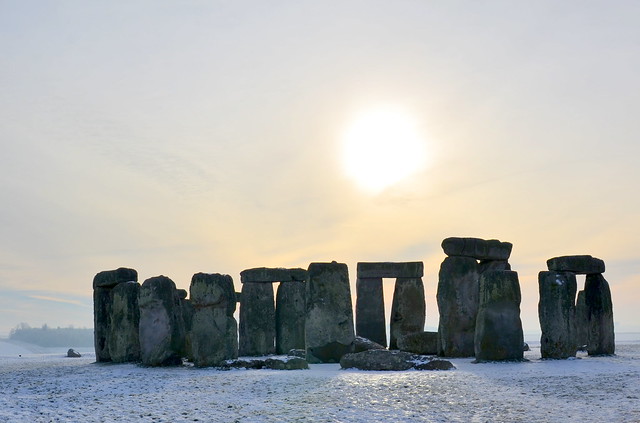
The Winter Solstice is the solar day where there is the shortest time between the sun rising and the sun setting. It happens on December 21st or 22nd in the Northern Hemisphere. (In the Southern Hemisphere, this fourth dimension is the Summer Solstice and the Winter Solstice happens in tardily June.)
To pagans this meant that they knew that the days would start getting lighter and longer and the nights would become shorter - marking a change in the seasons. To gloat people had a mid-winter festival to celebrate the sunday 'winning' over the darkness of winter. At this time, animals which had been kept for food were also often killed to save having to feed them all through the winter and some drinks which had been brewing since the autumn/harvest would too exist fix to drink. So it was a good time to take a celebration with things to eat and drink before the residuum of the winter happened. (We nevertheless have New year's day celebrations nigh this time now!)
In Scandinavia, and some other parts of northern Europe, the time around the Winter Solstice is known as Yule (although the word Yule only seems to date to about the twelvemonth 300). In Eastern Europe the mid-winter festival is called Koleda.
In Iranian/Farsi civilisation, the wintertime solstice is known every bit 'Yalda Nighttime' or 'Shab-eastward Chelleh' and it's a time when families and friends come together to eat, drink and recite poetry. Shab-east Chelleh means 'night of forty' as it happens xl nights into winter. The word Yalda means 'birth' and comes from early Christians living in Persia celebrating the nascency of Jesus around this time. Eating, fruits, basics, pomegranates and watermelons are important at Yalda/Chelleh and you can go Yalda cakes which look like watermelons!
The Roman Festival of Saturnalia took place between December 17th and 23rd and honoured the Roman god Saturn. The Romans also thought that the Solstice took identify on December 25th. It'due south also thought that in 274 the Roman emperor Aurelian created 'Dies Natalis Solis Invicti' (pregnant 'altogether of the unconquered sun') also called 'Sol Invictus' and it was held on Dec 25th.
Because of the dates, some people say that the Christians 'took over' December 25th from these Roman festivals and/or Yule. However, there are records going back to around 200 of early on Christians connecting the Nisan 14 to the 25th March, and and so 25th Dec was a 'Christian' festival date many years earlier 'Sol Invictus'! (More than recent studies have also found that the 'Sol Invictus' connexion didn't appear until the 12th century and information technology'due south from 1 scribbled note in the margins of a manuscript. There's also bear witness that 'Sol Invictus' might also have happened in October and not December anyway!)
Christmas had likewise been celebrated by the early Church on Jan sixth, when they also celebrated the Epiphany (which ways the revelation that Jesus was God's son) and the Baptism of Jesus. (Like the December 25th date above, this was based on a adding of Jesus'south death/conception but from the 6th April not the 25th March.) Now Epiphany mainly celebrates the visit of the Wise Men to the babe Jesus, merely back then it historic both things! Jesus's Baptism was originally seen as more of import than his birth, as this was when he started his ministry.
The Jewish festival of Lights, Hanukkah starts on the eve of the Kislev 25 (the month in the Jewish calendar that occurs at nearly the aforementioned time every bit December). Hanukkah celebrates when the Jewish people were able to re-dedicate and worship in their Temple, in Jerusalem, once more following many years of not being allowed to practice their organized religion.
Jesus was a Jew, and then this could be another reason that helped the early Church choose December the 25th for the date of Christmas!
Virtually of the world uses the 'Gregorian Calendar' implemented past Pope Gregory 13 in 1582. Earlier that the 'Roman' or Julian Agenda was used (named afterwards Julius Caesar). The Gregorian agenda is more accurate than the Roman calendar which had likewise many days in a yr! When the switch was made ten days were lost, and so that the twenty-four hour period that followed the fourth October 1582 was 15th October 1582. In the UK the change of calendars was made in 1752. The day after 2nd September 1752 was 14th September 1752.
Many Orthodox and Coptic Churches still use the Julian Calendar and so celebrate Christmas on the 7th January (which is when December 25th would have been on the Julian agenda). And the Armenian Apostolic Church celebrates it on the 6th January! In some office of the United kingdom of great britain and northern ireland, January 6th is still called 'Old Christmas' equally this would have been the twenty-four hours that Christmas would accept celebrated on, if the calendar hadn't been changed. Some people didn't want to use the new calendar as they idea it 'cheated' them out of 11 days!
Christians believe that Jesus is the lite of the earth, so the early Christians thought that this was the correct fourth dimension to celebrate the birth of Jesus. They besides took over some of the community from the Winter Solstice and gave them Christian meanings, like Holly, Mistletoe and even Christmas Carols!
St Augustine of Canterbury was the person who probably started the widespread celebration of Christmas in large parts of England by introducing Christianity to the regions run by the Anglo-Saxons in the 6th century (other Celtic parts of U.k. were already Christian simply in that location aren't many documents virtually if or how they celebrated the nativity of Jesus). St Augustine of Canterbury was sent past Pope Gregory the Great in Rome and that church used the Roman Calendar, so western countries celebrate Christmas on the 25th Dec. Then people from Britain and Western Europe took Christmas on the 25th Dec all over the world!
If you'd like to know more about the history behind the dating of Christmas, then read this very adept article on Bible History Daily (goes to another site).
And so when was Jesus Born?
In that location's a strong and practical reason why Jesus might not take been born in the wintertime, merely in the spring or the autumn! Information technology can get very cold in the winter and information technology's unlikely that the shepherds would have been keeping sheep out on the hills (as those hills can become quite a lot of snow sometimes!).
During the leap (in March or April) there's a Jewish festival chosen 'Passover'. This festival remembers when the Jews had escaped from slavery in Egypt almost 1500 years before Jesus was born. Lots of lambs would have been needed during the Passover Festival, to be sacrificed in the Temple in Jerusalem. Jews from all over the Roman Empire traveled to Jerusalem for the Passover Festival, so it would have been a skilful time for the Romans to take a census. Mary and Joseph went to Bethlehem for the demography (Bethlehem is nearly six miles from Jerusalem).
In the autumn (in September or Oct) in that location's the Jewish festival of 'Sukkot' or 'The Feast of Tabernacles'. It's the festival that'due south mentioned the most times in the Bible! It is when Jewish people call up that they depended on God for all they had later on they had escaped from Egypt and spent twoscore years in the desert. It also celebrates the end of the harvest. During the festival, Jews live outside in temporary shelters (the word 'tabernacle' come from a latin give-and-take meaning 'booth' or 'hut').
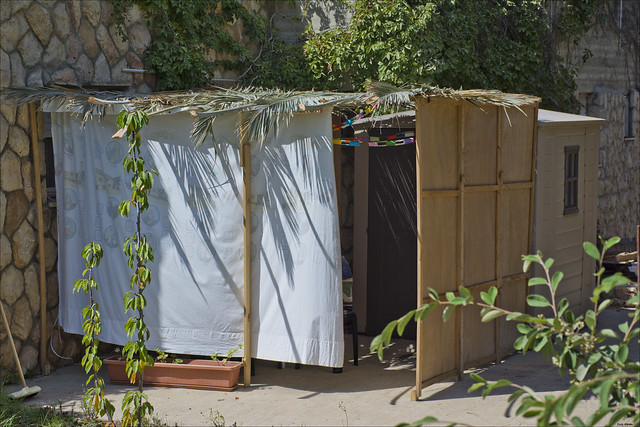
Many people who accept studied the Bible, think that Sukkot would be a likely fourth dimension for the nascence of Jesus every bit it might fit with the description of there being 'no room in the inn'. It as well would have been a skillful time to accept the Roman Demography as many Jews went to Jerusalem for the festival and they would take brought their own tents/shelters with them! (It wouldn't take been practical for Joseph and Mary to carry their ain shelter every bit Mary was meaning.)
The possibilities for the Star of Bethlehem seems to point either leap or autumn.
The possible dating of Jesus birth can too be taken from when Zechariah (who was married to Mary'due south cousin Elizabeth) was on duty in the Jewish Temple as a Priest and had an amazing feel. In that location is an excellent article on the dating of Christmas based on the dates of Zechariah's feel, on the blog of theologian, Ian Paul. With those dates, you get Jesus being born in September - which also fits with Sukkot!
In the Bible, John 1:14 says "The Word became flesh and fabricated his dwelling among us...". In Greek the word for 'dwelling' is 'eskēnōsen' (ἐσκήνωσεν) which means 'to pitch and live in a tent/encampment'. In Hebrew this translates as 'mishkan' ('מִשְׁכַּן' meaning to dwell and it's also the proper name given to the Tabernacle which was where God 'dwelled' in the Jewish and Christian religion during the Jews time in the wilderness in the volume of Exodus) and/or 'sukkah' ('סוכה'). And then John seems to accept clearly been drawing on this analogy saying that Jesus 'pitched his tent' every bit a human and likewise quite maybe he is making the link to the time of Jesus'due south birth. John certainly knew both Jesus and Mary and and then would have known when Jesus was born!
The year that Jesus was born isn't known. The agenda organisation we have now was created in the 6th Century by a monk called Dionysius Exiguus. He was actually trying to create a better system for working out when Easter should be celebrated, based on a new agenda with the birth of Jesus being in the twelvemonth 1. Withal, he made a error in his maths and so got the possible yr of Jesus'southward birth wrong!
Most scholars now retrieve that Jesus was born between two BCE/BC and 7 BCE/BC, possibly in 4 BCE/BC. Earlier Dionysius's new calendars, years were normally dated from the reigns of Roman Emperors. The new calendar became more widely used from the 8th Century when the 'Venerable Bede of Northumbria' used information technology in his 'new' history book! In that location is no year '0'. Bede started dating things before the year 1 and used 1 BCE/BC every bit the first year before i. At that time in Europe, the number 0 didn't exist in maths - it but arrived in Europe in the 11th to 13th centuries!
Then whenever you celebrate Christmas, call back that you're celebrating a real event that happened about 2000 years agone, that God sent his Son into the globe as a Christmas present for everyone!
Also every bit Christmas and the solstice, there are some other festivals that are held in belatedly Dec. Hanukkah is historic past Jews; and the festival of Kwanzaa is celebrated by some Africans and African Americans takes place from December 26th to January 1st.
Detect out why Christmas is sometimes chosen Xmas!
Source: https://www.whychristmas.com/customs/25th.shtml
0 Response to "When Will Christmas Eve Be on Monday Again"
Postar um comentário