Coat of Arms Coat of Arms Family Crest
Family Coat of Artillery Explanation
What is a Coat of Artillery?
Heraldry arose in the 11th and 12th centuries, around the fourth dimension of the Crusades, a serial of military campaigns undertaken by Christian armies from 1096 to 1487. In battle, a knight dressed head to toe in armor would non be recognizable to friend or foe, so a new method of identification became necessary. The shield, heraldry's most recognizable component, provided a broad, flat surface on which to paint colors and symbols assigned to a item nobleman and his knights. A nobleman likewise commonly wore an outer garment chosen a surcoat to protect him from the estrus of the lord's day, oftentimes decorated with the same devices that appeared on a knight's shield. It is from this garment that the phrase "glaze of arms" is derived.
The origins of heraldry stretch back into aboriginal times. Warriors often busy their shields with patterns and mythological motifs. Army units of the Roman Empire were identified past the distinctive markings on their shields. These were not heraldic in the medieval sense, as they were associated with military units, not individuals or families.
The Heraldic Clarification of a Glaze of Arms
The official, written description of the coat of artillery is called the "type of artillery". The blazon may seem like a foreign linguistic communication, merely it is just a system of code words to denote colors, placement, and styling by using an economy of words.
Much of the design for a modern depiction of a given glaze of arms is more the artist'due south preference or the style of a particular herald, and non a part of whatever particular blazon. The mantling and the banners for names and mottoes, for example, are not an official element of the blazon of arms. Some historians adhere a significance to the design of the captain or helmet every bit representative of a certain century or social status, merely there are differences of opinion on this affair.
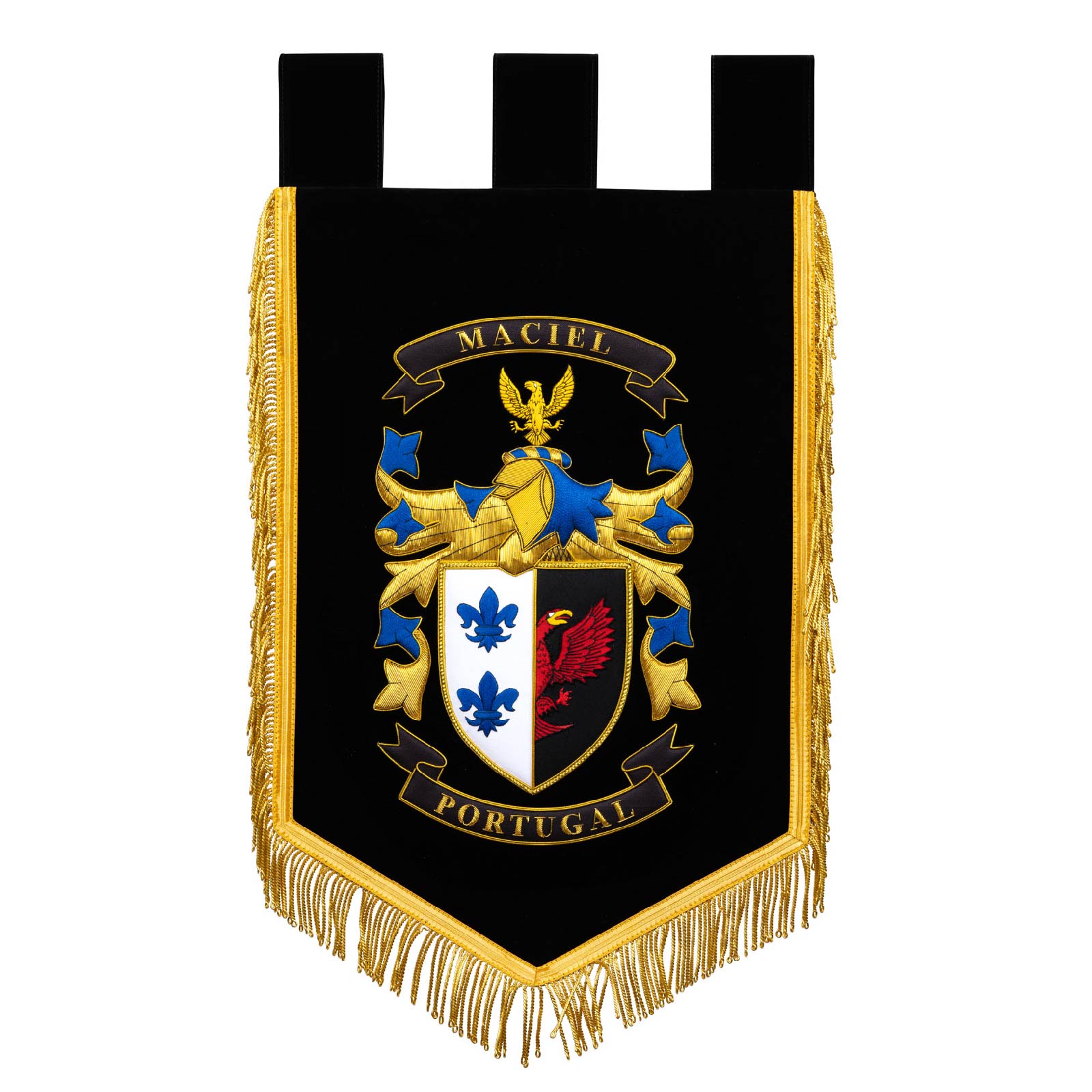
Colors & Pregnant in a "family crest" or Coat of Artillery
| Gold | Generosity and elevation of the mind |
| Argent or White (Silverish) | Peace and sincerity |
| Reddish (Gules) | Warrior or martyr, War machine strength and magnanimity |
| Blue (Azure) | Truth and loyalty |
| Greenish (Vert) | Promise, joy, and loyalty in beloved |
| Black (Sable) | Constancy or grief |
| Purple (Purpure) | Imperial majesty, sovereignty, and justice |
| Orangish (Tawny or Tenne) | Worthy ambition |
| Maroon (Sanguine or Murray) | Patient in battle, and yet victorious |
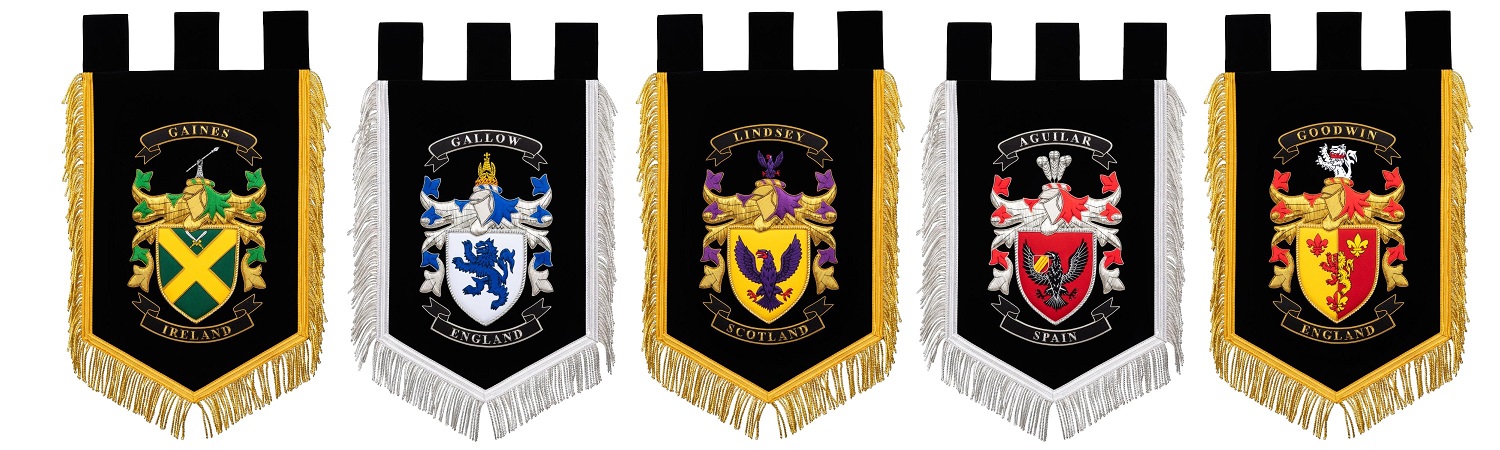
The Escutcheon or Shield
The shield is the essential component of an armorial achievement; without it there can be no total heraldic display. Armorial bearings are generally referred to more briefly as arms or equally a glaze of arms, a term derived from the surcoat of silk or linen worn over the armor to continue off the rays of the sun and to filibuster the formation of rust on the armor. The surcoat is a garment resembling a waistcoat that displays the same heraldic insignia as the shield.
Every other object in a full heraldic accomplishment is dependent upon the shield or coat of arms.
The Crest
The technical use of the heraldic term crest refers to just one component of a consummate achievement. The crest has evolved from the 3-dimensional figure placed on the top of the helm as a further means of identification. The crest rests atop the helmet, which in turn rests on the nearly important part of the achievement: the shield. The crest is a common offshoot of the shield and consists of any object or objects placed above information technology. When shown above the shield, the crest normally arises out of a wreath fabricated of twisted ribbons in the two principal tinctures of the shield. Crests do not always accompany the shield, as they are not a required add-on.
The Wreath or Torse
The torse or wreath is a twisted roll of fabric wound around the top of the helm and crest to support the mantle, the protective cloth covering worn over a knight'southward helmet. The torse comprises a pair of ribbons twisted together, tinctured of the two chief metal and colors of the shield, the livery colors. The torse was sometimes held to correspond a token from the crusader's lady-love, given to him when he left for war, a sort of handkerchief which he twisted round the superlative of his helmet, masking the bring together where the crest was affixed.
The Helmet or Helm
On height of the shield is placed the helmet, upon which the crest is fastened by a wreath, coronet, or chapeau. The helmet is of import in showcasing the armorial bearings. The shape of the helmet has varied greatly in heraldic representation. While the bones features of heraldry remain consistent, the modes in which the insignia are shown take been discipline to changes in fashion.
The Mantling
When the helm and crest are shown, they are ordinarily accompanied by a mantling or lambrequin. The mantling was made of linen or other cloth to shield the wearer from the sun'southward rays; it also served to snare or deflect sword cuts. Today it takes the form of a stylized cloak, with the outer surface generally in the principal color of the shield and the inner surface in the principal metal. The mantling is sometimes depicted with a ragged edge, as if damaged in combat, though this is at the emblazoner's discretion.
Mottoes
Mottoes have often get the starting point of myths and legends—time and over again, a phrase or short sentence that began life equally an inspiration or exhortation has caused a fantastic explanation. An armorial motto is a phrase intended to describe the wearer'due south motivation or intention. Some mottoes are sometime war cries. Others are puns of the owner'due south name or title, such equally the Seton war cry of "Set on." French and Latin are the most popular languages, but Gaelic and Greek likewise announced. Mottoes are generally changed at volition and do non make up an integral role of the armorial achievement.
Supporters
Supporters are ii matching figures that are usually depicted holding upward either side of the shield. Supporters are traditionally beasts, birds, monsters, humans or mythical animals. Today, their use is generally express to civic and municipal coats of arms, or for people who accept achieved great notoriety. The figures may be real or imaginary animals, humans, or in rare cases, plants or inanimate objects.
Occasionally, the coat of arms will feature just one unmarried supporter, which is generally an eagle with i or two heads, although there are other examples.
Source: https://www.mylineage.com/family-coat-of-arms-explanation/
0 Response to "Coat of Arms Coat of Arms Family Crest"
Postar um comentário